

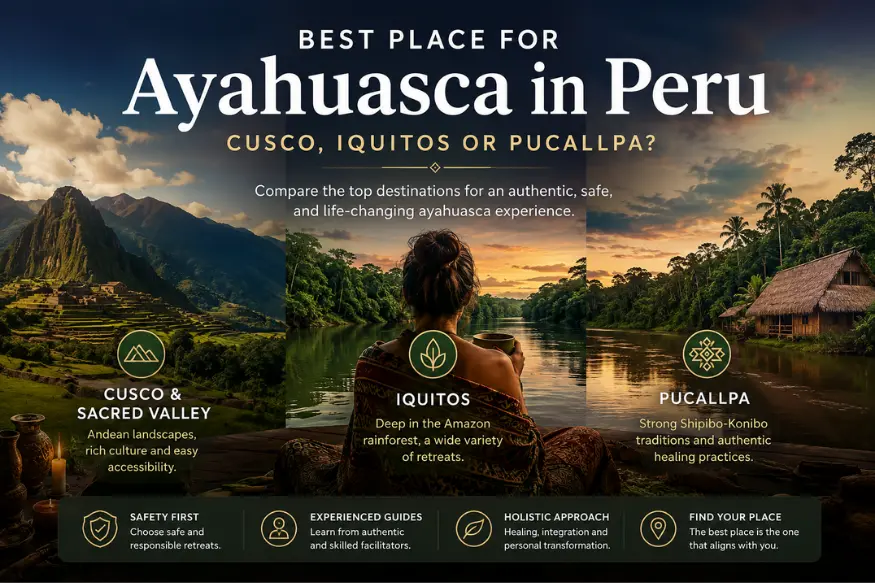
Peru is one of the main destinations travelers consider when looking for an ayahuasca experience. But choosing Peru is only the beginning.
The next question is where to go.
Three areas frequently appear when researching ayahuasca in Peru: Cusco and the Sacred Valley, Iquitos, and Pucallpa.
Each offers a very different environment.
Iquitos provides an Amazon rainforest setting and a large selection of retreat centers. Pucallpa has particularly strong connections with Shipibo-Konibo traditions. Cusco and the Sacred Valley combine an Andean setting with relatively convenient access for travelers already exploring southern Peru.
There is no single location that is right for everyone.
The best place for ayahuasca in Peru depends on the environment you want, how remote you are comfortable being, your travel itinerary, and, most importantly, the individual retreat you choose.
This guide compares Cusco and the Sacred Valley, Iquitos, and Pucallpa to help you understand the differences before choosing where to attend a retreat.
Cusco vs Iquitos vs Pucallpa: Quick Comparison
| Cusco & Sacred Valley | Iquitos | Pucallpa | |
|---|---|---|---|
| Environment | Andes and mountain valleys | Amazon rainforest | Amazon rainforest |
| Climate | Cooler, with dry and rainy seasons | Hot and humid | Hot and humid |
| Access | Flight to Cusco + road transfer | Flight to Iquitos + possible road/boat transfer | Flight to Pucallpa + local transfer |
| Travel style | Easy to combine with southern Peru | Dedicated Amazon experience | More specialized Amazon experience |
| Retreat selection | Good selection | Large selection | Established Amazonian retreat scene |
| Traditional context | Amazonian and Andean influences vary by retreat | Multiple Amazonian traditions | Strong Shipibo-Konibo presence |
| Good for | Travelers combining retreat + Peru itinerary | Travelers wanting rainforest immersion | Travelers interested in Shipibo-Konibo traditions |
These are broad differences.
The quality and safety of an individual retreat matter considerably more than the city or region where it is located.
Ayahuasca in Cusco and the Sacred Valley
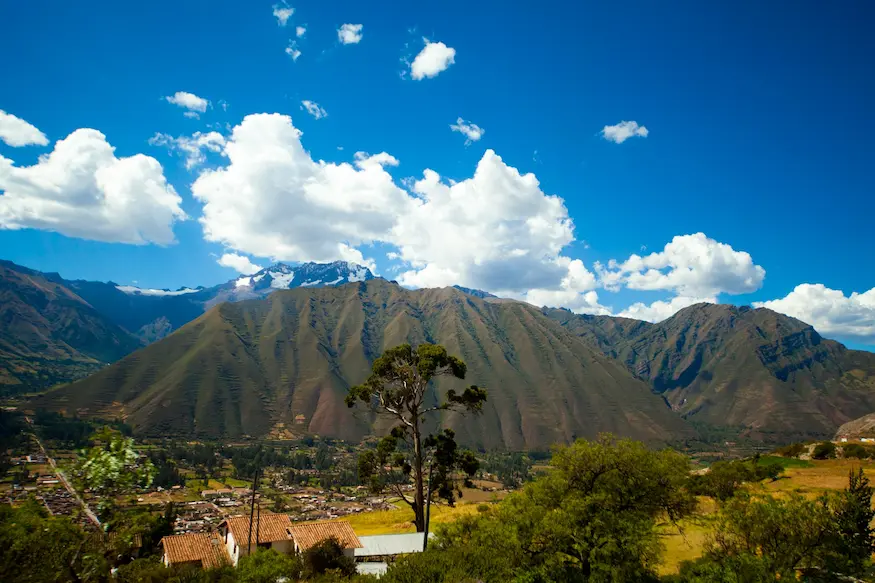
Cusco is one of Peru’s principal tourism hubs and the starting point for many travelers visiting Machu Picchu and the Sacred Valley.
Ayahuasca retreats advertised as being in Cusco are often located outside the city, particularly in the Sacred Valley.
The environment is dramatically different from the Amazon.
Instead of dense tropical rainforest, participants are surrounded by mountains, agricultural valleys, rivers, traditional communities, and high-altitude Andean landscapes.
The Sacred Valley can therefore be particularly attractive to travelers who want an ayahuasca experience without making a separate journey deep into the Amazon.
If this region interests you, our guide to Ayahuasca Retreat Cost in the Sacred Valley provides a more detailed look at retreat prices, accommodations, accessibility, and what programs in the valley typically include.
Why Choose the Sacred Valley for Ayahuasca?
One of the biggest advantages is accessibility.
Travelers can fly from Lima to Cusco and continue by road into different parts of the Sacred Valley.
This makes the region relatively easy to incorporate into a larger Peru itinerary.
The Sacred Valley also provides established tourism infrastructure while allowing retreat centers to operate away from the traffic and activity of central Cusco.
Travelers can remain surrounded by mountains and nature while still being within reasonable driving distance of Cusco.
For those already planning to visit southern Peru, this can considerably simplify logistics.
Things to Consider in Cusco and the Sacred Valley
Altitude is an important consideration.
Cusco sits at approximately 3,400 meters above sea level, while much of the Sacred Valley is lower but still at significant elevation.
Travelers arriving directly from sea level can experience headaches, fatigue, nausea, changes in appetite, or difficulty sleeping while adjusting to altitude.
These symptoms can complicate the period immediately before a retreat.
If your itinerary allows, avoid creating an unnecessarily rushed schedule between arriving in Cusco and beginning your retreat.
The climate is another consideration.
Daytime conditions can be warm and sunny, while nights can become considerably cooler than in the Amazon.
Check what type of accommodation and ceremonial space the retreat provides.
Ayahuasca in Iquitos
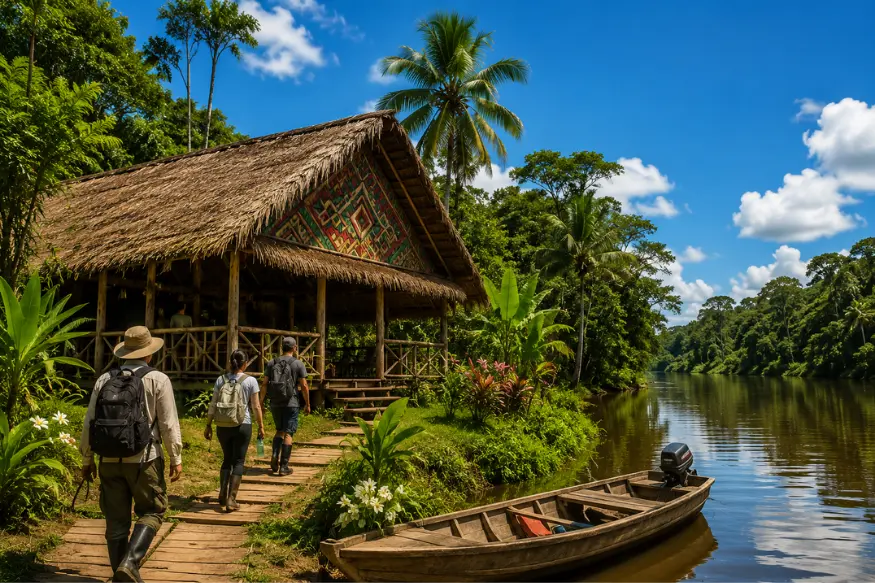
Iquitos is probably Peru’s best-known Amazonian destination among international travelers researching ayahuasca.
Located in northeastern Peru, the city is surrounded by the Amazon rainforest.
Unlike Cusco, Iquitos is not connected by road to Lima or Peru’s main highway network. Most international travelers reach the city by air.
From Iquitos, retreat centers range from relatively accessible properties to remote jungle locations that may require additional transportation by road or boat.
Why Choose Iquitos for Ayahuasca?
The rainforest itself is one of the main reasons travelers choose Iquitos.
If you imagine an ayahuasca retreat surrounded by tropical vegetation, rivers, humidity, insects, wildlife, and dense jungle, Iquitos provides that environment.
There is also a substantial retreat industry, giving travelers many different programs to compare.
This variety can be useful, but it makes researching individual centers especially important.
If Iquitos is one of your main options, read our detailed Ayahuasca Retreat Cost in Iquitos guide before comparing programs. It covers typical price ranges as well as additional expenses such as domestic flights and transportation to jungle retreat centers.
Things to Consider in Iquitos
The Amazon climate is hot and humid.
Mosquitoes and other insects are normal parts of the environment, and accommodation standards can differ significantly between retreat centers.
Location also matters.
Some retreats are relatively close to the city, while others require longer transfers into the rainforest.
Before booking a remote retreat, ask:
How long does it take to reach the property?
Is transportation by boat required?
Is transportation possible at night?
How does the retreat communicate with the outside world?
What happens during a medical emergency?
How long would it take to reach medical assistance?
A remote setting can be part of the attraction, but you should understand the practical implications before arriving.
Cusco vs Iquitos
Many travelers eventually narrow their decision down to these two destinations.
The biggest difference is the environment.
Cusco and the Sacred Valley provide mountains, cooler temperatures, easier connections with southern Peru, and relatively straightforward transportation.
Iquitos provides rainforest immersion and a journey centered much more specifically around the Amazon.
If these are your final two options, our complete Ayahuasca Retreat Cusco vs Iquitos comparison explores accessibility, costs, environment, accommodation, and the type of traveler each destination may suit.
Ayahuasca in Pucallpa
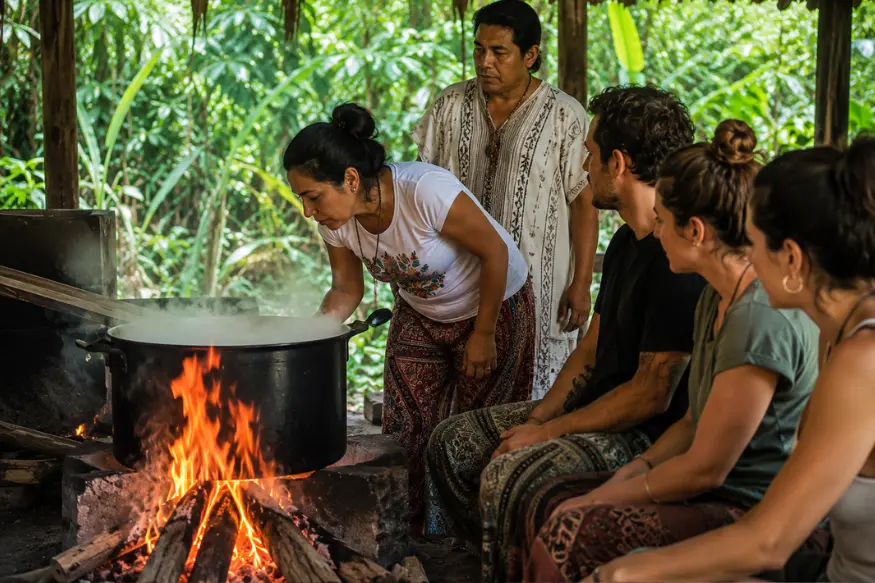
Pucallpa is another important Amazonian city associated with ayahuasca.
Located on the Ucayali River, the region has particularly strong connections with the Shipibo-Konibo people.
For travelers specifically interested in Shipibo-Konibo traditions, Pucallpa frequently appears during retreat research.
Why Choose Pucallpa for Ayahuasca?
Pucallpa appeals to travelers who want an Amazon environment but may be particularly interested in the cultural traditions associated with the region.
Shipibo-Konibo art, songs, plant knowledge, and ceremonial practices have become internationally associated with ayahuasca.
However, travelers should avoid assuming that every retreat in Pucallpa represents these traditions in the same way.
Research who actually conducts the ceremonies and what relationship the retreat has with the practitioners and communities it references.
If you’re considering this region, our guide to Ayahuasca Retreat Cost in Pucallpa explains typical retreat prices, travel considerations, accommodations, and how Pucallpa compares with other destinations in Peru.
Things to Consider in Pucallpa
Like Iquitos, Pucallpa has a tropical climate.
Heat, humidity, insects, and rainfall are normal considerations when staying outside the city.
Retreats may also be located some distance from urban medical facilities.
Ask how transportation works and how quickly participants could reach medical assistance if necessary.
Pucallpa also receives fewer conventional international tourists than Cusco, which may appeal to travelers specifically interested in an Amazon-focused trip rather than a broader sightseeing itinerary.
Pucallpa vs Sacred Valley
These destinations provide almost opposite environments.
Pucallpa offers Amazon rainforest surroundings and strong connections with Shipibo-Konibo traditions.
The Sacred Valley provides mountains, cooler conditions, easier access from Cusco, and the possibility of combining the retreat with other destinations in southern Peru.
We compare these differences in much greater detail in our Ayahuasca Retreat Pucallpa vs Sacred Valley guide.
Sacred Valley vs Amazon for Ayahuasca
For many travelers, the real decision is not necessarily Cusco versus Iquitos versus Pucallpa.
It is Andes versus Amazon.
The environments are completely different.
Consider the Sacred Valley if you prefer:
Mountain landscapes.
Cooler temperatures.
Easier connections with Cusco.
Less humidity.
A retreat that fits naturally into a southern Peru itinerary.
Convenient access before or after visiting other destinations in the region.
Consider the Amazon if you prefer:
Tropical rainforest.
Hot and humid conditions.
A trip centered specifically around the jungle.
Greater physical separation from Peru’s conventional tourism routes.
Retreat traditions closely connected with Amazonian regions and communities.
Neither environment makes an ayahuasca experience inherently better.
Location is only one factor.
Is Iquitos Better Than Cusco for Ayahuasca?
Not necessarily.
Iquitos may be more appropriate if your priority is experiencing the Amazon rainforest.
Cusco or the Sacred Valley may make more sense if you want easier travel logistics, cooler conditions, mountain surroundings, or a retreat that fits into a larger Peru itinerary.
The quality of the individual retreat matters more than the destination name.
A responsible retreat in the Sacred Valley is preferable to a poorly managed retreat in Iquitos, and the reverse is equally true.
Evaluate the individual center rather than assuming one city guarantees a particular experience.
Is Pucallpa Better Than Iquitos?
Again, there is no universal answer.
Pucallpa may particularly interest travelers researching Shipibo-Konibo traditions.
Iquitos has a larger international tourism profile and a broad selection of jungle retreat centers.
Both provide Amazonian environments but can produce very different travel experiences.
The better option depends on the specific retreat, practitioner, accessibility, accommodation, safety practices, and environment you want.
Do not choose solely because one destination is marketed as more “authentic.”
Authenticity depends much more on the people and practices involved than on a city name.
Does Ayahuasca Differ Between Regions of Peru?
Ayahuasca is not a standardized pharmaceutical product.
Preparations, plant combinations, ceremonial traditions, songs, practices, and terminology can differ between practitioners and regions.
Even within the same destination, two retreats may conduct ceremonies very differently.
This is another reason why comparing cities alone is insufficient.
Ask what preparation is used, who conducts the ceremonies, what traditions inform their practices, and how participants are supervised.
Safety Matters More Than Location
A remote jungle retreat is not automatically more authentic.
A comfortable Sacred Valley retreat is not automatically safer.
Regardless of destination, evaluate:
Health screening.
Medication screening.
Facilitator experience.
Group size.
Staff-to-participant ratio.
Emergency procedures.
Access to medical assistance.
Physical safety of the property.
Respect for personal boundaries.
Integration support.
Before choosing a retreat, read our guide on how to choose a safe ayahuasca retreat in Peru.
You should also understand ayahuasca contraindications and potential ayahuasca medication interactions before making travel arrangements.
How Remote Should Your Ayahuasca Retreat Be?
Isolation can be appealing.
Many travelers intentionally choose retreats away from cities because they want fewer distractions and more contact with nature.
But remote does not automatically mean better.
The farther a retreat is from medical infrastructure, the more important its emergency procedures become.
Ask how transportation works, whether vehicles can reach the property, whether boats are required, what communication systems are available, and what would happen during an emergency at night.
The answers should be specific.
How Many Days Should You Stay?
Location is only one decision.
You also need to determine how much time you want to dedicate to the retreat.
A 1-Day Ayahuasca Retreat can suit travelers with limited time who want a shorter program in the Sacred Valley.
Longer programs provide more time within the retreat environment for ceremonies, rest, and integration before returning to normal travel.
Do not assume that longer automatically means better.
Consider your health, previous experience, travel schedule, screening results, retreat structure, and the amount of recovery time you want.
You can compare the available Ayahuasca Retreats in Peru before choosing a program based solely on duration.
Consider What Happens After the Ceremony
Where you stay after the ceremony matters too.
Immediately returning to airports, overnight buses, crowded accommodations, or demanding tours may not be ideal after an intense experience.
Some travelers prefer remaining at the retreat.
Others arrange quiet accommodation nearby before continuing their trip.
The primary effects of ayahuasca occur over hours, but fatigue, emotional sensitivity, disrupted sleep, or reflection may continue afterward.
Understanding how long ayahuasca lasts can help you build a more realistic travel itinerary.
The process of ayahuasca integration may continue considerably longer than the acute effects themselves.
Can You Combine an Ayahuasca Retreat With Machu Picchu?
Yes.
This is one of the logistical advantages of choosing Cusco or the Sacred Valley.
However, avoid creating an overly compressed itinerary.
Machu Picchu, trekking, long transfers, early-morning trains, altitude changes, and an ayahuasca ceremony can all be physically demanding in different ways.
Allow recovery time between major activities.
If the retreat is an important part of your trip, avoid filling the following morning with transportation and sightseeing before knowing how you will feel.
When Is the Best Time for Ayahuasca in Peru?
The answer depends partly on location.
Peru’s Andes and Amazon have very different climates.
The Sacred Valley experiences a more pronounced dry and rainy season, with generally cooler temperatures because of elevation.
Iquitos and Pucallpa remain tropical throughout the year, with heat, humidity, rainfall, and river conditions playing a larger role.
Ayahuasca ceremonies are not limited to one particular season.
Weather matters primarily because it affects transportation, accommodation, comfort, and the overall environment surrounding your retreat.
How to Choose Between Cusco, Iquitos and Pucallpa
Start with the retreat itself rather than the destination.
Consider:
Health and medication screening.
Who conducts the ceremonies.
Experience of the facilitators.
Emergency procedures.
Access to medical assistance.
Group size.
The environment you prefer.
How remote you want to be.
Your tolerance for altitude, heat, and humidity.
Your broader Peru itinerary.
The amount of time you have available.
The cultural or traditional context you are seeking.
The city should help narrow your search.
It should not replace evaluating the individual retreat.
Final Considerations
So, where is the best place for ayahuasca in Peru?
Cusco and the Sacred Valley may make the most sense for travelers who prefer the Andes, cooler temperatures, relatively easy logistics, and the possibility of combining a retreat with other destinations in southern Peru.
Iquitos may suit travelers specifically seeking an Amazon rainforest environment and a broad selection of jungle retreats.
Pucallpa may particularly interest travelers looking for an Amazon experience with strong connections to Shipibo-Konibo traditions.
None is automatically the best.
Choose the environment that fits your trip, then evaluate the individual retreat much more carefully than the destination.
Screening, supervision, facilitator experience, emergency procedures, personal boundaries, accommodations, and post-ceremony support should ultimately carry more weight than whether the address says Cusco, Iquitos, or Pucallpa.
Frequently Asked Questions
Where is the best place in Peru for ayahuasca?
Cusco and the Sacred Valley, Iquitos, and Pucallpa are three major destinations to consider. The best option depends on the retreat itself, the environment you prefer, travel logistics, and the traditions you are interested in.
Is Cusco or Iquitos better for ayahuasca?
Cusco and the Sacred Valley offer an Andean environment and easier integration with a southern Peru itinerary. Iquitos provides an Amazon rainforest setting and a broad selection of jungle retreats. Neither is universally better.
Is Pucallpa good for ayahuasca retreats?
Pucallpa has strong connections with Shipibo-Konibo traditions and attracts travelers specifically interested in an Amazonian environment. Individual retreats should still be evaluated carefully for screening, supervision, facilities, and emergency procedures.
Is Iquitos or Pucallpa better for ayahuasca?
Iquitos has a larger international retreat industry, while Pucallpa is particularly associated with Shipibo-Konibo traditions. The better choice depends on the specific retreat, travel logistics, accommodations, and the type of Amazon experience you want.
Where can I do ayahuasca near Machu Picchu?
The Sacred Valley and Cusco region have ayahuasca retreat centers and are within the same broader tourism region used by travelers visiting Machu Picchu. Leave adequate recovery time rather than scheduling demanding travel immediately after a ceremony.
Is ayahuasca better in the Amazon?
Not inherently. The Amazon provides the rainforest environment historically associated with many ayahuasca traditions, but location alone does not determine the quality or safety of a ceremony.
Are ayahuasca retreats in Peru safe?
Safety varies between individual retreats. Evaluate health screening, medication policies, facilitator experience, supervision, emergency procedures, personal boundaries, location, and access to medical assistance before booking.