

Ayahuasca Ingredients: What Is Ayahuasca Made Of?
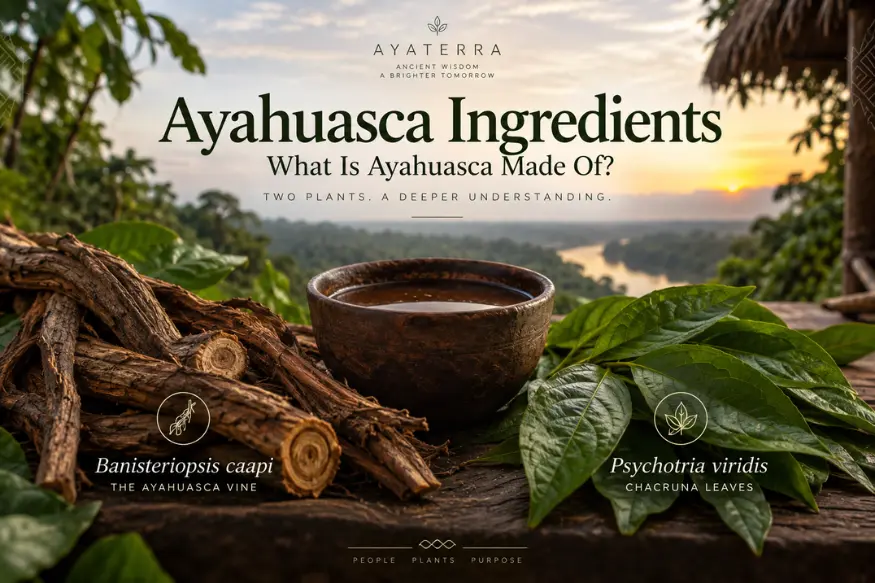
Traditional ayahuasca is usually prepared from two main Amazonian plants: the Banisteriopsis caapi vine and the leaves of Psychotria viridis, commonly known as chacruna.
Although the recipe sounds simple, the two plants play very different roles. Chacruna contains DMT, while the ayahuasca vine contains harmala alkaloids that inhibit monoamine oxidase (MAO), allowing orally consumed DMT to become active.
However, not every preparation called ayahuasca contains exactly the same plants. Ingredients can vary between regions, Indigenous traditions, and practitioners.
Here is a closer look at the main ayahuasca ingredients, what each plant contributes, and how they are traditionally prepared.
What Are the Main Ingredients in Ayahuasca?
The two ingredients most commonly associated with traditional ayahuasca are:
| Ingredient | Scientific name | Main compounds | Role in the brew |
|---|---|---|---|
| Ayahuasca vine | Banisteriopsis caapi | Harmine, harmaline, tetrahydroharmine | Provides MAO-inhibiting harmala alkaloids |
| Chacruna leaves | Psychotria viridis | DMT | Provides the primary psychedelic compound |
Water is used to cook the plant material and reduce the liquid into the final brew.
So, in one of the most widely documented preparations, the ingredient list is remarkably short:
Banisteriopsis caapi + chacruna + water.
The chemistry behind the combination, however, is considerably more complex.
1. Banisteriopsis Caapi: The Ayahuasca Vine
Banisteriopsis caapi is a woody climbing vine native to tropical South America.
It is commonly called the ayahuasca vine, although regional names vary.
The vine is not simply an inactive base used to carry the other ingredients. It contains several important beta-carboline alkaloids, particularly:
Harmine
Harmaline
Tetrahydroharmine (THH)
These compounds are central to the pharmacology of traditional ayahuasca.
Normally, enzymes called monoamine oxidases rapidly metabolize orally consumed DMT. Harmala alkaloids from B. caapi temporarily inhibit MAO-A, which allows DMT from the accompanying plant material to become orally active.
This interaction between the vine and the DMT-containing plant is one of the defining characteristics of many ayahuasca preparations.
Is Banisteriopsis Caapi Psychoactive by Itself?
Yes, Banisteriopsis caapi has psychoactive properties of its own.
The effects of the vine alone are different from those typically associated with a DMT-containing ayahuasca brew. Its harmala alkaloids can affect perception and consciousness and can also produce physical effects such as nausea.
This is important because ayahuasca should not be understood simply as “liquid DMT.”
The vine itself is an active component of the preparation.
2. Chacruna: The DMT-Containing Leaf
The second major ingredient is chacruna, scientifically known as Psychotria viridis.
Chacruna is a shrub native to the Amazon and other tropical areas of South America.
Its leaves contain N,N-dimethyltryptamine (DMT), a powerful psychedelic compound.
You can read more about the plant itself in our guide to chacruna.
When DMT is consumed orally by itself, enzymes in the digestive system and liver normally break it down rapidly.
The harmala alkaloids in Banisteriopsis caapi change that.
By temporarily inhibiting MAO-A, they allow DMT from chacruna to reach systemic circulation and produce its characteristic psychedelic effects.
We explain the compound separately in our guide to DMT.
Why Does Ayahuasca Use Two Plants?
This is one of the most interesting aspects of ayahuasca.
Neither plant performs exactly the same function.
Chacruna provides DMT.
Banisteriopsis caapi provides harmala alkaloids that inhibit MAO-A.
When used together, their pharmacological interaction makes orally consumed DMT active for a period of time.
This combination is responsible for many of the perceptual and psychological effects commonly associated with ayahuasca.
Traditional Amazonian explanations of the plants may differ considerably from this pharmacological description. Indigenous traditions can understand plants through cultural, medicinal, spiritual, and relational frameworks that cannot be reduced solely to their chemical compounds.
Both perspectives are worth distinguishing rather than treating them as interchangeable explanations.
Is Chacruna Always Used in Ayahuasca?
No.
Psychotria viridis is one of the best-known DMT-containing plants used with Banisteriopsis caapi, particularly in Peru and parts of the western Amazon.
But it is not the only one.
Different Amazonian regions and traditions may use other plants.
One important example is Diplopterys cabrerana, commonly called chagropanga or chaliponga in some regions.
Like chacruna, it can contain DMT and may be combined with Banisteriopsis caapi.
This means there is no single universal ayahuasca recipe used everywhere in South America.
Does Every Ayahuasca Brew Have the Same Ingredients?
No.
The term “ayahuasca” covers a variety of traditional preparations.
Recipes can differ according to:
Geographic region
Indigenous tradition
Plant availability
Practitioner
Purpose of the preparation
The proportions of vine and leaves can also vary.
Even when two brews contain the same species, differences in plant material, concentration and preparation can result in different chemical compositions.
For this reason, two ayahuasca brews should not automatically be assumed to have identical potency or effects.
Are Other Plants Added to Ayahuasca?
Sometimes.
Certain traditional preparations may include additional plants depending on the lineage, region, or intended use.
However, this is an important safety consideration.
Adding another plant changes the chemical composition of the brew and may introduce additional pharmacological effects or risks.
A participant therefore has a legitimate reason to ask a retreat or practitioner exactly what is in the ayahuasca they will be served.
A responsible answer should be specific rather than simply saying that the brew contains “plant medicine.”
What Is Ayahuasca Made From in Peru?
In Peru, one of the most familiar combinations is:
Banisteriopsis caapi vine + Psychotria viridis (chacruna) leaves + water.
The plant material is cooked in water for an extended period and the resulting liquid is reduced into a concentrated brew.
Preparation methods differ among traditions and practitioners, so there is not one standardized recipe followed throughout Peru.
The preparation can involve repeated cooking and reduction before the final liquid is ready for ceremonial use.
How Is Ayahuasca Traditionally Prepared?
The exact process varies, but traditional preparation generally involves cleaning and preparing the vine, combining it with leaves, and cooking the plant material in water.
The vine may be cut, crushed, or pounded before cooking.
Layers of vine and leaves can then be arranged in a large pot with water.
The mixture is cooked for many hours.
As water evaporates, the liquid becomes increasingly concentrated. Some preparations involve multiple rounds of cooking and filtering before the liquid is reduced to the desired consistency.
The final brew is usually brown and has a strong, bitter, earthy flavor.
Preparation is not merely a chemical extraction process within many Amazonian traditions. The person preparing the brew, the plants selected, and the traditional practices surrounding preparation may all have cultural significance.
Is Ayahuasca Just DMT?
No.
This is a common oversimplification.
DMT is an important component of many ayahuasca preparations, but traditional ayahuasca also contains pharmacologically active harmala alkaloids from the Banisteriopsis caapi vine.
The combination changes both how DMT is absorbed and the overall pharmacological profile of the brew.
Ayahuasca should therefore not be treated as chemically equivalent to isolated DMT.
The experiences are also different in duration, setting, preparation, and cultural context.
Which Ayahuasca Ingredient Causes Visions?
DMT from chacruna or another DMT-containing plant is strongly associated with the visual and perceptual effects of ayahuasca.
Participants may report colors, geometric patterns, people, animals, landscapes, memories, or complex dreamlike scenes.
However, ayahuasca experiences cannot be predicted simply from the ingredients.
Some people experience intense visual phenomena, while others experience relatively few visuals.
Our guide to ayahuasca visions looks specifically at this part of the experience.
Which Ingredient Causes Ayahuasca Purging?
It is difficult to attribute nausea or vomiting to one ingredient alone.
Ayahuasca can produce gastrointestinal effects, including nausea, vomiting, and diarrhea, and individual responses vary considerably.
The Banisteriopsis caapi vine itself can contribute to nausea and vomiting, while the complete brew and its concentration can also influence physical effects.
Vomiting is therefore not simply the body’s reaction to DMT.
If you want to understand this part of the experience in more detail, see our guide to ayahuasca purging.
Are Ayahuasca Ingredients Safe?
“Natural” does not automatically mean safe.
The harmala alkaloids in Banisteriopsis caapi inhibit MAO-A and can interact with certain medications and other substances.
This is particularly important for people taking medications that affect serotonin or other monoamine systems.
Ayahuasca may also be inappropriate for people with certain physical or psychiatric conditions.
For this reason, knowing the ingredients is only one part of safety. Appropriate medical screening and honest disclosure of medications and health history are important before participating.
Our ayahuasca contraindications guide explains situations that may require avoiding ayahuasca or obtaining appropriate medical advice.
Participants should not discontinue prescription medication simply to attend an ayahuasca ceremony without consulting a qualified healthcare professional.
Why Knowing the Ingredients Matters
If you are considering an ayahuasca retreat, asking what is actually in the brew is reasonable.
You should know whether the preparation contains only the expected vine and leaf combination or whether additional plants or substances have been added.
This matters for several reasons:
Allergic or adverse reactions
Medication interactions
Unexpected psychoactive compounds
Differences in potency
Informed consent
A retreat should be transparent about what participants are consuming.
This is one of several practical factors to consider when learning how to choose a safe ayahuasca retreat.
Ayahuasca Ingredients at Ayaterra
At Ayaterra, the ayahuasca brew used in our ceremonies is prepared from Banisteriopsis caapi, chacruna, and water.
The preparation is made in Peru following the traditional practices used by the shamans who work with the medicine.
Participants undergo screening before attending a retreat and receive information about preparation and ceremony procedures.
Understanding what you are drinking is part of approaching an ayahuasca experience responsibly.
Frequently Asked Questions About Ayahuasca Ingredients
What are the ingredients in ayahuasca?
One of the most common traditional preparations combines Banisteriopsis caapi vine with Psychotria viridis (chacruna) leaves and water. Recipes can vary between regions and traditions.
What plant is ayahuasca made from?
Ayahuasca commonly contains at least two plants: the Banisteriopsis caapi vine and a DMT-containing plant such as Psychotria viridis. The word ayahuasca is also frequently used specifically for the B. caapi vine.
Does ayahuasca contain DMT?
Many ayahuasca preparations contain DMT because they include chacruna or another DMT-containing plant. However, not every preparation called ayahuasca necessarily has the same ingredients.
What does Banisteriopsis caapi do in ayahuasca?
Banisteriopsis caapi contains harmala alkaloids that inhibit MAO-A. This allows orally consumed DMT from plants such as chacruna to become active. The vine also has psychoactive properties of its own.
What does chacruna do in ayahuasca?
Chacruna (Psychotria viridis) provides DMT in many traditional ayahuasca preparations.
Is ayahuasca just DMT?
No. Traditional ayahuasca contains other active compounds, particularly harmala alkaloids from Banisteriopsis caapi. Its pharmacology is therefore different from isolated DMT.
Are there different ayahuasca recipes?
Yes. Ingredients, proportions, preparation techniques, and additional plants can vary between Amazonian regions, Indigenous traditions, and practitioners.
Can other plants be added to ayahuasca?
Yes. Some traditions use additional plants, although these can introduce different pharmacological effects and risks. Participants should know exactly what ingredients are being served.
Final Thoughts
The main ayahuasca ingredients in one of the most widely used traditional preparations are surprisingly simple: Banisteriopsis caapi vine, chacruna leaves, and water.
What makes the brew unusual is the interaction between the two plants.
Chacruna provides DMT, while Banisteriopsis caapi provides harmala alkaloids that inhibit MAO-A and allow DMT to become orally active. At the same time, the vine contains psychoactive compounds of its own and has a central place in Amazonian ayahuasca traditions.
Recipes are not identical everywhere, however.
Different regions and traditions may use different plants or preparation methods, which is why anyone considering an ayahuasca ceremony should know exactly what ingredients are present in the brew they will consume.