

Ayahuasca Ceremony Experience: What to Expect
Ayahuasca Ceremony Experience: What to Expect
An ayahuasca ceremony experience can be difficult to imagine before participating for the first time. What happens when you arrive? What is the ceremonial room like? When do you drink ayahuasca? What happens during the following hours, and what happens when the ceremony ends?
Although every ceremony and every participant’s experience can be different, most structured ceremonies follow a general sequence of preparation, drinking the brew, several hours of guided ceremonial experience, rest, and integration afterward.
This guide walks you through the experience step by step so you can better understand what an ayahuasca ceremony may actually be like.
Before the Ayahuasca Ceremony
The experience usually begins well before drinking ayahuasca.
At a structured retreat, participants first become familiar with the location, meet the facilitators and shaman, and receive instructions about how the ceremony will work.
This is also an opportunity to ask practical questions.
You should know where the bathroom is, where you will sit or lie down, how to request assistance, and who will remain in the ceremonial space throughout the night.
Participants may also spend some quiet time reflecting on why they decided to attend.
Some people call this setting an intention.
It does not need to be complicated. It may simply be something you want to understand, reflect on, or approach with greater awareness.
Entering the Ceremonial Space
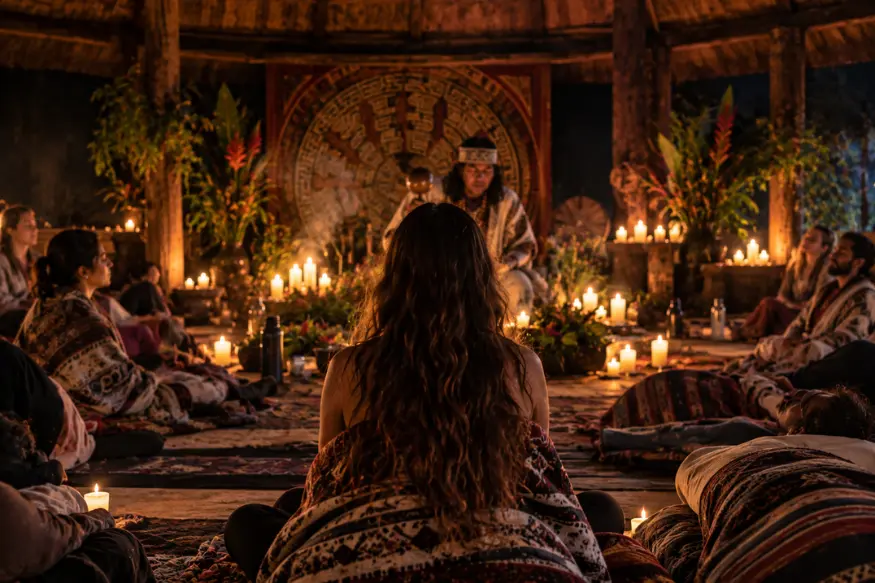
Ayahuasca ceremonies are commonly held in a quiet room or ceremonial space where participants can remain comfortably for several hours.
Depending on the tradition and retreat, people may sit or lie on mattresses, cushions, or individual spaces arranged around the room.
Lighting is generally kept low.
The atmosphere is intentionally calm because participants can become highly sensitive to sound, movement, light, and the presence of other people once the effects begin.
Before drinking ayahuasca, the shaman or facilitators may explain the final instructions and allow participants a few moments to settle themselves.
At Ayaterra, our Ayahuasca Ceremony in the Sacred Valley includes preparation in the main ceremonial room, or maloka, before the ceremony begins.
Drinking Ayahuasca
Participants are generally called individually to receive the ayahuasca brew.
The amount served can vary depending on the ceremony and the people conducting it.
Ayahuasca typically has a strong and distinctive taste. Some people find it bitter or earthy, while others find the flavor difficult to describe.
After drinking, participants return to their place and wait quietly.
Nothing necessarily happens immediately.
There can be a period where the room remains quiet while participants wait for the effects to develop.
For a first-time participant, this waiting period can bring a mixture of curiosity, nervousness, and anticipation.
When the Effects Begin
The transition into the ayahuasca experience is not identical for everyone.
Some participants notice physical sensations first.
Others notice changes in thoughts, emotions, sound, or visual perception.
Possible experiences include:
Changes in body temperature
Tingling or heaviness
Nausea
Changes in perception
Increased emotional sensitivity
Altered sense of time
Introspection
Visual imagery
The experience may develop gradually rather than arriving all at once.
If you want a more detailed explanation of the physical, emotional, and perceptual effects, see our guide to what ayahuasca feels like.
What Happens During an Ayahuasca Ceremony?
Once the effects become stronger, attention often shifts inward.
Participants generally remain in their individual spaces while the shaman conducts the ceremony.
This part of the experience can vary enormously from person to person.
One participant may spend much of the ceremony quietly reflecting.
Another may experience vivid imagery.
Someone else may feel strong emotions or physical discomfort.
Some people move through several of these states during the same ceremony.
There is no single experience that everyone is supposed to have.
Music and Icaros During the Ceremony
Sound can play an important role in traditional ayahuasca ceremonies.
In Shipibo-Konibo traditions, shamans may sing ceremonial songs commonly known as icaros.
During an altered state of consciousness, music and singing may feel much more prominent than they normally would.
Participants may find themselves focusing closely on the rhythm, melody, or voice of the shaman.
The ceremonial environment is therefore not simply a room where people drink ayahuasca.
The sounds, silence, lighting, people present, and way the ceremony is conducted all contribute to the experience.
What Do You See During an Ayahuasca Ceremony?
Some participants report visual experiences, while others experience few or no visions.
Possible visual experiences can include colors, geometric patterns, scenes, memories, people, animals, landscapes, or abstract imagery.
These experiences can occur with the eyes closed and may sometimes feel dreamlike or unusually vivid.
However, having visions is not a requirement for having an ayahuasca experience.
Some ceremonies are primarily emotional or introspective.
Others may involve strong physical sensations with relatively little imagery.
Our separate guide to ayahuasca visions explores this aspect of the experience in greater detail.
Emotional Experiences During the Ceremony
Emotions can become unusually intense.
A participant may experience sadness, fear, gratitude, affection, relief, confusion, or joy.
These feelings can also change throughout the ceremony.
Someone might begin feeling nervous, later experience a difficult emotional period, and eventually become calm.
Others may spend much of the ceremony quietly observing their thoughts.
Past experiences or memories can also come to mind.
Because emotional responses are unpredictable, a responsible ceremony should include people who remain available to assist participants when needed.
Purging During an Ayahuasca Ceremony
Vomiting is one of the best-known physical experiences associated with ayahuasca, although it does not happen to everyone.
Nausea may gradually increase before vomiting occurs.
Ceremonial spaces commonly provide individual buckets so participants do not need to leave their place when they feel sick.
Some people vomit once, others several times, and some do not vomit at all.
Not vomiting does not mean the ayahuasca “didn’t work.”
Likewise, participants should not deliberately try to make themselves vomit.
We explain this experience separately in our guide to ayahuasca purging.
Can an Ayahuasca Ceremony Feel Difficult?
Yes.
An ayahuasca ceremony is not necessarily peaceful or pleasant throughout.
Possible difficult moments can include:
Nausea
Vomiting
Fear
Confusion
Intense emotions
Difficult memories
Feeling temporarily overwhelmed
Uncomfortable physical sensations
This is one reason the environment and support team matter.
A participant who becomes uncomfortable should be able to ask for assistance without having to leave the ceremonial environment alone.
Difficult experiences should also not automatically be interpreted as beneficial or necessary. How someone responds during and after the experience matters.
Can You Talk or Move Around During the Ceremony?
This depends on the retreat’s rules and on what is necessary.
Participants are generally encouraged to remain in their individual spaces to avoid disturbing other people’s experiences.
However, you may need to use the bathroom, change position, sit up, lie down, or request help.
Because coordination and perception can be altered, moving around should be done carefully.
If assistance is available, participants should ask for help rather than attempting to navigate unfamiliar spaces while strongly affected.
How Long Does an Ayahuasca Ceremony Feel?
Ayahuasca can alter the perception of time.
A period that objectively lasts minutes may sometimes feel much longer.
For this reason, participants may lose track of how much time has passed during the strongest part of the experience.
Rather than watching the clock, most people spend the ceremony focused on what they are experiencing internally.
Eventually, the intensity generally begins to decrease.
Thoughts may become easier to organize, physical sensations become less prominent, and awareness of the room becomes more ordinary again.
What Happens as the Ceremony Ends?
The end is usually gradual rather than abrupt.
Participants may begin sitting up, drinking water, resting, or quietly observing the room.
Some people feel peaceful.
Others feel exhausted.
Some may want to talk about what happened, while others prefer silence.
The immediate period after a ceremony is not necessarily the best time to reach conclusions about everything that occurred.
An experience that seemed confusing during the night may feel different after sleeping and reflecting on it.
The Morning After an Ayahuasca Ceremony
The following morning can feel very different from the ceremony itself.
Participants may feel rested, tired, emotionally sensitive, calm, reflective, or simply hungry.
A structured retreat generally allows time for breakfast, hydration, rest, and discussion.
At Ayaterra, ceremonies are followed by an integration meeting where participants can discuss the previous experience and receive support in processing what occurred. citeturn0search0
Integration should not be treated as an attempt to assign a fixed meaning to every vision or sensation.
Sometimes the most useful approach is simply to describe what happened and allow time to reflect on it.
Is Every Ayahuasca Ceremony Experience Different?
Yes.
Even the same person can have dramatically different experiences on different nights.
A first ceremony might involve strong physical effects.
A second may be more emotional.
Another may feel quiet and introspective.
There is no required progression.
This is also why doing more ceremonies does not automatically guarantee a deeper or stronger experience.
If you are considering a multi-day retreat, our guide to how many ayahuasca ceremonies explains the differences between attending one, two, or several ceremonies.
What Is a First Ayahuasca Ceremony Like?
For first-time participants, one of the biggest differences is simply that everything is unfamiliar.
You do not yet know:
How the brew will taste
How your body will respond
Whether you will experience nausea
Whether you will have visions
How intense your emotions may become
How time will feel
What the ceremonial environment will feel like
That uncertainty can create nervousness before the ceremony.
Once the experience begins, however, participants often become much more focused on what is happening internally than on what they expected beforehand.
A first ceremony should therefore not be approached with a checklist of experiences that are supposed to happen.
What Should You Expect From Your Ayahuasca Ceremony?
Expect uncertainty.
You can understand the structure of a ceremony beforehand, but you cannot know exactly what your individual experience will be.
You may have visions or none.
You may purge or not.
The experience may feel emotional, physical, introspective, challenging, peaceful, or several of these things at different moments.
The purpose of preparation is not to predict the experience.
It is to understand the environment, know what to do if you need assistance, and enter the ceremony without expecting a specific outcome.
Experiencing an Ayahuasca Ceremony at Ayaterra
Ayaterra holds ceremonies in the Sacred Valley of Cusco in small groups with shamans and a support team present throughout the experience.
For travelers who want to experience a single ceremony without committing to a longer multi-day program, the 1-Day Ayahuasca Retreat provides preparation, one ayahuasca ceremony, and post-ceremony integration within a shorter retreat format. citeturn0search2
Longer retreats allow additional time for rest, integration, and subsequent ceremonies.
Whichever format you choose, the number of ceremonies should be considered alongside preparation, screening, supervision, recovery time, and the support available before and after the experience.
Frequently Asked Questions
What happens at an ayahuasca ceremony?
Participants generally receive preparation and instructions before drinking ayahuasca in a quiet ceremonial environment. The following hours may involve physical sensations, changes in perception, emotions, introspection, visions, nausea, or purging while the ceremony is guided by a shaman and support team.
What does an ayahuasca ceremony feel like?
There is no single feeling. Experiences can include physical sensations, emotional intensity, altered perception, introspection, visual imagery, nausea, calm, fear, or changes in the perception of time.
Do you see things during an ayahuasca ceremony?
Some people report vivid visual experiences, but others experience few or no visions. Visuals are not required for an ayahuasca experience.
Do you vomit during an ayahuasca ceremony?
Vomiting can occur, but not everyone vomits. Nausea and other gastrointestinal effects are possible, and not vomiting does not mean the experience was unsuccessful.
Can a first ayahuasca ceremony be scary?
It can feel challenging or frightening for some participants, particularly because perception and emotions can change significantly. Appropriate screening, preparation, supervision, and access to support are important.
What happens after an ayahuasca ceremony?
Participants usually rest as the effects diminish. The following hours or morning may include sleep, food, hydration, reflection, and an integration conversation or meeting.
Final Thoughts
An ayahuasca ceremony experience is more than the period when the psychoactive effects are strongest.
It begins with preparation and entering the ceremonial environment, continues through drinking the brew and the hours that follow, and extends into rest and integration afterward.
The exact physical, emotional, and perceptual experience cannot be predicted.
Understanding the structure beforehand, however, can remove some of the uncertainty—especially for someone approaching their first ceremony.
Rather than expecting a particular vision, emotional breakthrough, or physical reaction, it is more realistic to understand what happens during the ceremony and how you will be supported throughout it.